
There is a version of “Classic+” that turns into fan-fiction with a production budget: kill one famous character early, rewrite a faction, send everyone to a zone that never opened in 2004, and see how far the butterfly effect can fly.
WoW Forever is not starting there.
In a fresh Sportskeeda interview, Principal Game Designer Kris Zierhut describes Forever as an adjacent timeline that splits from the original game on the equivalent of launch day. The important part is the second half of his answer: the team wants the world to remain very close to the Azeroth Classic players recognize, with the freedom to tell slightly different stories rather than immediately throwing the old history off a cliff.
That boundary explains a surprising amount of what Blizzard has shown so far — from Forsaken Paladins to Riverglades, and even the stuff the developers are refusing to promise yet.
An adjacent timeline, not a lore demolition derby
Zierhut compares Forever to an adjacent timeline: nearly the same starting point, with divergence beginning around the launch-day version of original WoW. Senior Game Designer Michael Nuthals describes the goal as telling new stories that feel like they could have happened in that world.
That gives Blizzard room to solve two problems at once.
First, it can stop treating every loose end from 2004 as untouchable museum glass. An unfinished road can open. A forgotten faction can get another chapter. A class combination that would once have broken faction symmetry can exist.
Second, Forever does not need to race toward Retail’s history just because that is what happened the first time. Zierhut’s example is simple: Forever is not going to Molten Core at launch, even though Molten Core belongs to the original era. It can arrive when this version of Azeroth is ready for it.
If you want Classic with room for a few surprises, that is an encouraging direction. If you want a complete reinvention of your class, this interview does not promise one.
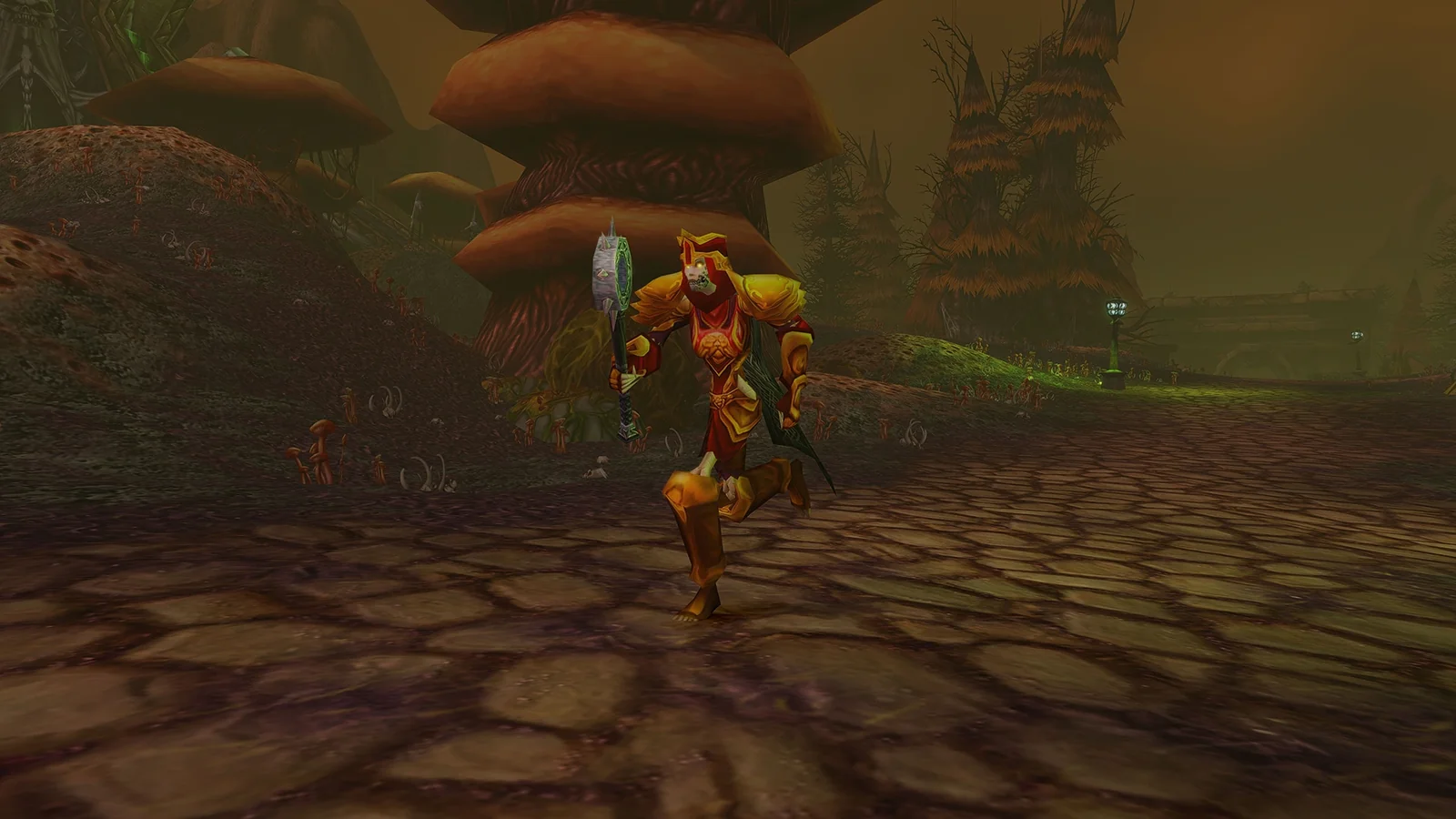
Forsaken Paladin comes directly from a lesson Blizzard learned in Season of Discovery
The interview gets especially interesting when Zierhut talks about Paladins and Shamans.
He explains that Season of Discovery was a chance to explore the road Blizzard did not take with The Burning Crusade: keep Paladins and Shamans faction-exclusive, then try to solve the balance and gameplay problems that follow.
His conclusion is refreshingly practical: the problems created by maintaining that separation were worse than letting both factions access the archetypes.
That does not mean Horde and Alliance become interchangeable. Forever is still using faction-specific race/class combinations and distinct stories. But it explains why Forsaken Paladin and Dwarf Shaman are not being treated as sacred-line violations that need to wait for a later expansion.
This is one of the places Forever benefits from Blizzard having already spent years experimenting with Classic variants. The team is not guessing what strict faction separation feels like in 2026. It has recent evidence from Season of Discovery.
Do not expect Warlock tanks and Rogue tanks at launch
Season of Discovery also created the opposite expectation: if Blizzard is willing to change the old rules, why not let classes play entirely new roles again?
Nuthals gives a clear launch answer: not yet. New role conversions are not part of the Forever launch target. The stated goal is to keep the game recognizable and approachable for existing Classic players; Paladins on Horde, Shamans on Alliance, Gnome Priests and Troll Warlocks are already a significant opening shift.
He leaves the door open for new classes or new class roles later. That is not an announcement.
This distinction matters because community speculation turns “we can imagine this in the future” into a roadmap bullet at terrifying speed. ForeverAtlas is keeping the useful sentence and dropping the wishcasting:
No major off-role class conversions at launch. Future possibilities remain possibilities.
The new quests are not just about making the world denser
The interview also gives us a better explanation for where Blizzard is putting new quests.
Nuthals says the team looked for places where the leveling journey narrowed into too few reasonable choices. Zierhut specifically points to the 30–50 range as an area where players often had fewer routes.
That makes the “1,000+ new quests” number more interesting. The value is not merely having more yellow exclamation marks. It is creating alternate paths for a second character — or a fifth — so the optimal answer is not identical every time.
There is also a deliberate early-game goal. Zierhut says the team wants returning players to encounter something unfamiliar within roughly the first ten levels: that small moment where your Classic memory says, wait, was that NPC always there?
That is exactly the reaction Forever needs to produce. The game can use the same hills, roads and inns without feeling like another fresh-server rerun.
Riverglades has a Warcraft I thread hiding in it
Nuthals names Sunnyglade, a ruined town in Riverglades drawn from Warcraft I, as an example of how the team is pulling old Warcraft threads into new localized stories.
It is a small detail, but it tells us something about the tone. Forever’s new worldbuilding does not need every quest hub to reveal a cosmic secret. A half-forgotten RTS map name can be enough to make a place feel connected to Warcraft history.
Controller support is not an afterthought
The interview is unusually enthusiastic about controller support.
Zierhut and Nuthals describe it as fully and officially supported in Forever, with beta feedback still expected to shape the experience. They also call out accessibility directly: controller support opens WoW to players who cannot comfortably use a keyboard and mouse, including people using specialized accessibility controllers.
That is more meaningful than “the buttons technically work.”
The beta should tell us how well the promise holds up in practical areas: targeting, inventory management, talent spending, chat, party management, dense quest hubs and raid frames. Movement can feel excellent on a stick while a bag full of quest items still turns into menu wrestling.
If Forever really wants to welcome returning players who now prefer a couch to a desk, this is one of those features that can quietly matter more than a flashy new dungeon.
Gilneas, Uldum and Caverns of Time: exciting ideas, not a roadmap
Then the interview wanders into the dangerous part: developers being asked what they would love to build someday.
Gilneas comes up. Uldum comes up. A Caverns of Time-themed battleground comes up. The developers talk about the appeal of visiting places in their pre-Cataclysm context and exploring unfinished corners of the old world.
And they explicitly warn that these are long-term ideas, not promises.
So this is where the hype needs a leash.
It is completely reasonable to be excited by the thought of pre-Cataclysm Gilneas or the sealed Uldum gate finally opening in a Classic-shaped timeline. It is not reasonable to put “Gilneas zone confirmed” on a roadmap image tomorrow.
Forever has a structural advantage here: because the game is intended to keep expanding at level 60, all those old-world loose ends are potential future material. Potential is not schedule.
Blizzard does not want old content to become disposable
The most important endgame part of the interview may be less glamorous than Gilneas.
Nuthals and Zierhut talk about keeping content accessible rather than intentionally making it obsolete. Zierhut says every raid boss is intended to have a small number of rarer chase items that remain desirable after a player has already collected ordinary epics or a tier set.
The comparison he reaches for is something like Dragonspine Trophy: a drop that can keep a specific boss relevant long after the raid itself is familiar.
We do not have final drop rates, item names or a launch loot database from this interview. What we have is philosophy: horizontal level-60 progression works better when older bosses still have something somebody wants.
That also fits Forever’s broader “evergreen Azeroth” promise. If the whole game is supposed to remain a living level-60 world, the reward structure cannot simply tell everyone to abandon December’s raid when February arrives.
The shape of Forever is becoming clearer
Put the pieces together and this interview gives us a surprisingly coherent set of boundaries:
- the timeline can diverge, but the opening world should still feel like original WoW;
- familiar classes can change, but launch is not Season of Discovery 2;
- quest additions are meant to create route choices, not just inflate a content count;
- controller support is a first-class input and accessibility feature;
- unfinished places like Gilneas are fertile ground, but not automatically announced content;
- endgame content is supposed to keep reasons to revisit older raids.
That is a narrower vision than “Blizzard can do literally anything now,” and that is probably good news.
Forever does not need to shock us every five minutes. It needs to make an Azeroth we know well feel like it has unopened doors again.
The beta is where that philosophy stops being an interview answer and starts becoming something players can break, measure and argue about. We will be paying close attention to the exact places where the old rules bend — and just as importantly, the places where Blizzard deliberately leaves them alone.